
Probiotics

Probiotics

In-depth analyses of probiotic benefits, properties and challenges aiming to advance probiotic knowledge for the benefit of consumer health


Task Force Information

Objectives and list of Task Force members

Contact Information

Contact details in case you have specific questions

Activity Overview

Overview of ongoing and
upcoming activities

Expert Groups

Objectives, output and list of experts involved in each activity

Publications

List of publications of this
Task Force

Multimedia

Links to Task Force related documents, recordings and much more...

Completed Expert Groups

Details including experts involved of
each activity

Task Force Information

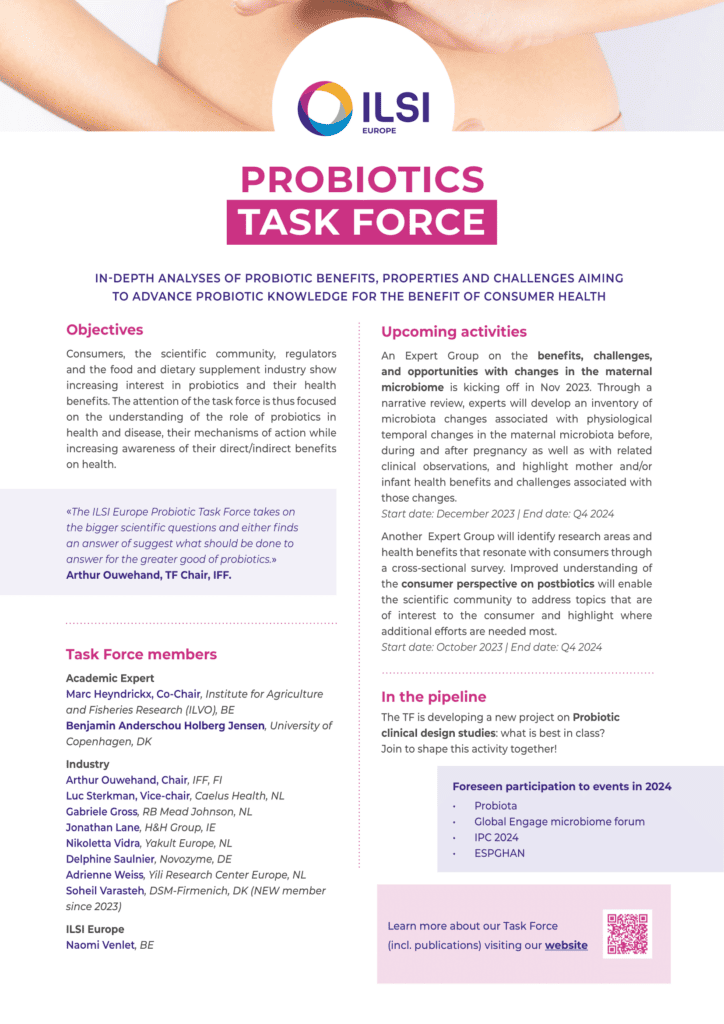
Objectives

Consumers, the scientific community, regulators and the food and dietary supplement industry show increasing interest in probiotics and their health benefits. The attention of the task force is thus focused on the understanding of the role of probiotics in health and disease, their mechanisms of action while increasing awareness of their direct/indirect benefits on health.

Task Force Members

WP DataTables

* Scientific Advisors

Contact Information

For more detailed information, please contact Maria Tonti at mtonti@ilsieurope.be

Activity Overview

Ongoing Activities

- Probiotic Clinical Study Design

The Expert Group will work on recommendations and a decision tree for designing effective probiotic clinical studies. This initiative will bring together experts from academia, industry, and regulatory bodies to enhance research quality by establishing reporting guidelines, streamlining study design, and developing reliable protocols tailored to the unique nature of live microbes.

The activity will involve a workshop on the 3rd of April 2025, at ILSI Europe office in Brussels. More info for the workshop to be announced soon.

Start date: Q4 2024 - End date: Q2 2025

- Markers of the Gut Microbiota

The group aims to identify key markers for assessing microbiota improvement, focusing on measurable indicators of microbiota composition and activity that are relevant to human health. This activity will address the need for standardized markers to evaluate dietary interventions, combining various indicators for comprehensive evaluation. The activity is shared with the Prebiotics Task Force.

Start date: Q1 2025 - End date: Q2 2026

Upcoming Activities

- Postbiotics for early life nutrition

An Expert group on  aims to explore the emerging role of postbiotics in infant nutrition through a focused, workshop-style debate involving experts in microbiota, pediatrics, and nutritional science. This initiative will identify key challenges, assess knowledge gaps, and develop recommendations to guide future research and applications. The outcomes will be published to support evidence-based guidance in infant and early childhood health. This is a joint activity with the Early Nutrition and Long-Term Health Task Force.

Start date: Q4 2025 - End date: Q2 2027

Expert Groups

Probiotic Clinical Study Design

Background and Objectives

The aim of this activity is to develop recommendations and a decision tree for designing effective probiotic clinical studies, taking into account the unique characteristics of live microbes. This initiative will gather input from experts in academia, CROs, industry, and regulatory bodies to enhance the quality and outcomes of probiotic research. The objectives include: (1) organizing a consensus workshop to establish proper reporting guidelines, (2) generating a decision tree to streamline study design, and (3) recommending study protocols that ensure control and reliability. The activity will also focus on identifying appropriate study designs for various research purposes and highlighting critical considerations specific to probiotics, including the importance of accurate study reporting.

Output

This activity will result in recommendations/ decision tree to optimize study design, taking into account the unique, live nature of probiotics.

Expert Group Members


WP DataTables

Publications

Oldest to Newest

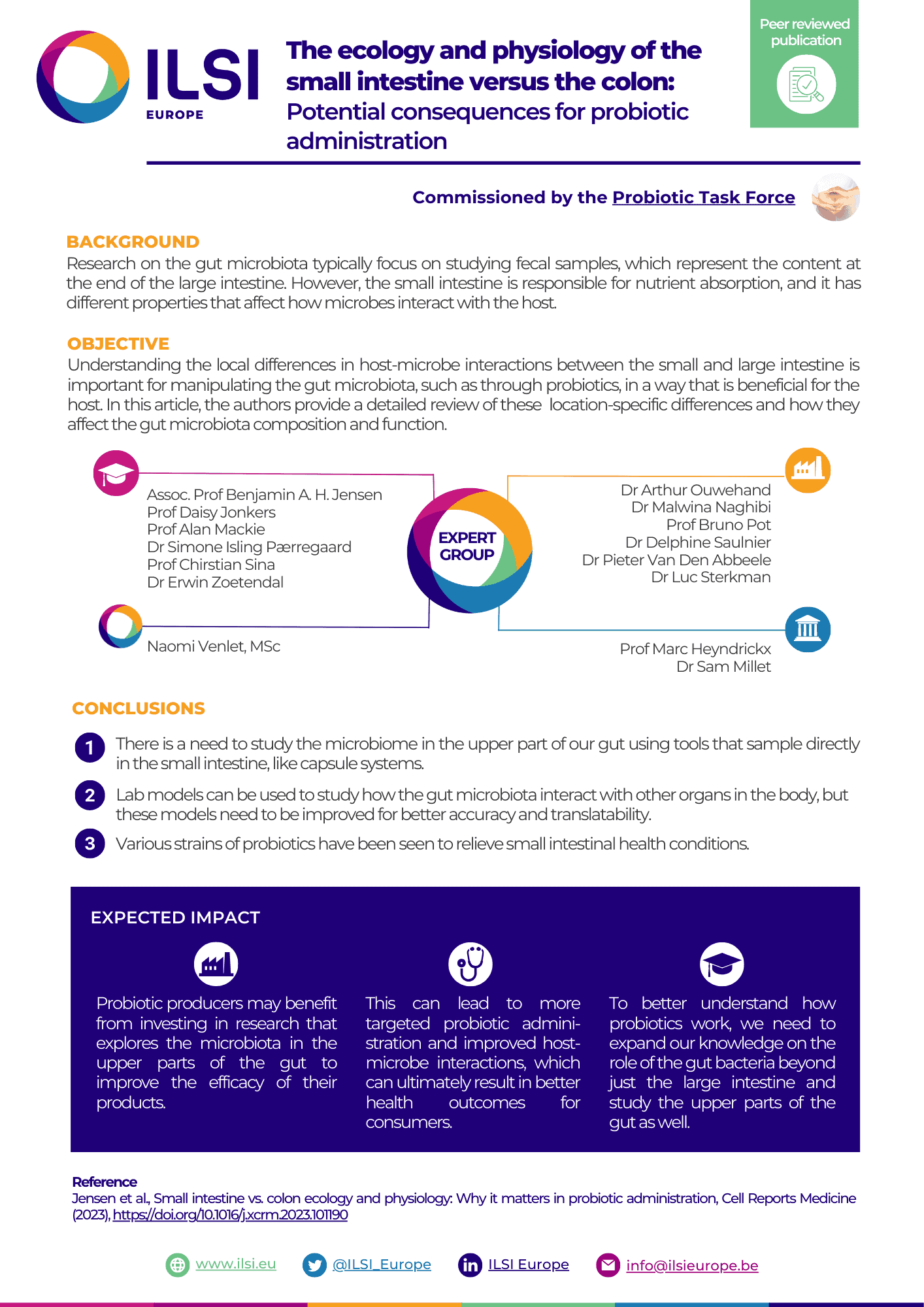
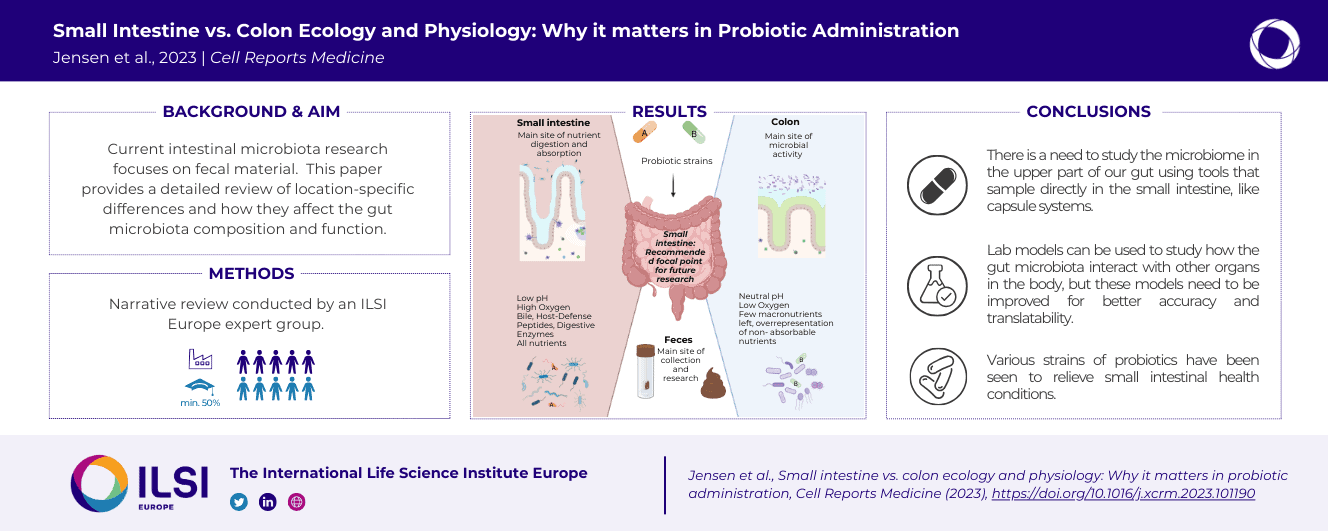
Small intestine vs. colon ecology and physiology: Why it matters in probiotic administration

We provide a detailed review unfolding how the physiological and anatomical differences between the small and large intestine affect gut microbiota composition, function, and plasticity. This information is key to understanding how gut microbiota manipulation, including probiotic administration, may strain-dependently transform host-microbe interactions at defined locations.
Read more

WP_Query Object
(
    [query] => Array
        (
            [post_type] => publication
            [posts_per_page] => 5
            [type] => 
            [area] => 
            [committee] => Probiotics
            [authors] => 
            [showtitle] => 
            [meta_query] => Array
                (
                    [relation] => AND
                )

            [tax_query] => Array
                (
                    [0] => Array
                        (
                            [taxonomy] => ilsi_committee
                            [field] => name
                            [terms] => Probiotics
                        )

                )

            [paged] => 3
            [meta_key] => _ilsi_date
            [orderby] => meta_value
            [order] => ASC
        )

    [query_vars] => Array
        (
            [post_type] => publication
            [posts_per_page] => 5
            [type] => 
            [area] => 
            [committee] => Probiotics
            [authors] => 
            [showtitle] => 
            [meta_query] => Array
                (
                    [relation] => AND
                )

            [tax_query] => Array
                (
                    [0] => Array
                        (
                            [taxonomy] => ilsi_committee
                            [field] => name
                            [terms] => Probiotics
                        )

                )

            [paged] => 3
            [meta_key] => _ilsi_date
            [orderby] => meta_value
            [order] => ASC
            [error] => 
            [m] => 
            [p] => 0
            [post_parent] => 
            [subpost] => 
            [subpost_id] => 
            [attachment] => 
            [attachment_id] => 0
            [name] => 
            [pagename] => 
            [page_id] => 0
            [second] => 
            [minute] => 
            [hour] => 
            [day] => 0
            [monthnum] => 0
            [year] => 0
            [w] => 0
            [category_name] => 
            [tag] => 
            [cat] => 
            [tag_id] => 
            [author] => 
            [author_name] => 
            [feed] => 
            [tb] => 
            [meta_value] => 
            [preview] => 
            [s] => 
            [sentence] => 
            [title] => 
            [fields] => all
            [menu_order] => 
             => 
            [category__in] => Array
                (
                )

            [category__not_in] => Array
                (
                )

            [category__and] => Array
                (
                )

            [post__in] => Array
                (
                )

            [post__not_in] => Array
                (
                )

            [post_name__in] => Array
                (
                )

            [tag__in] => Array
                (
                )

            [tag__not_in] => Array
                (
                )

            [tag__and] => Array
                (
                )

            [tag_slug__in] => Array
                (
                )

            [tag_slug__and] => Array
                (
                )

            [post_parent__in] => Array
                (
                )

            [post_parent__not_in] => Array
                (
                )

            [author__in] => Array
                (
                )

            [author__not_in] => Array
                (
                )

            [search_columns] => Array
                (
                )

            [ignore_sticky_posts] => 
            [suppress_filters] => 
            [cache_results] => 1
            [update_post_term_cache] => 1
            [update_menu_item_cache] => 
            [lazy_load_term_meta] => 1
            [update_post_meta_cache] => 1
            [nopaging] => 
            [comments_per_page] => 50
            [no_found_rows] => 
            [taxonomy] => ilsi_committee
            [term_id] => Probiotics
        )

    [tax_query] => WP_Tax_Query Object
        (
            [queries] => Array
                (
                    [0] => Array
                        (
                            [taxonomy] => ilsi_committee
                            [terms] => Array
                                (
                                    [0] => Probiotics
                                )

                            [field] => name
                            [operator] => IN
                            [include_children] => 1
                        )

                )

            [relation] => AND
            [table_aliases:protected] => Array
                (
                    [0] => wp_3_term_relationships
                )

            [queried_terms] => Array
                (
                    [ilsi_committee] => Array
                        (
                            [terms] => Array
                                (
                                    [0] => Probiotics
                                )

                            [field] => name
                        )

                )

            [primary_table] => wp_3_posts
            [primary_id_column] => ID
        )

    [meta_query] => WP_Meta_Query Object
        (
            [queries] => Array
                (
                    [0] => Array
                        (
                            [key] => _ilsi_date
                        )

                    [relation] => OR
                )

            [relation] => AND
            [meta_table] => wp_3_postmeta
            [meta_id_column] => post_id
            [primary_table] => wp_3_posts
            [primary_id_column] => ID
            [table_aliases:protected] => Array
                (
                    [0] => wp_3_postmeta
                )

            [clauses:protected] => Array
                (
                    [wp_3_postmeta] => Array
                        (
                            [key] => _ilsi_date
                            [compare] => =
                            [compare_key] => =
                            [alias] => wp_3_postmeta
                            [cast] => CHAR
                        )

                )

            [has_or_relation:protected] => 
        )

    [date_query] => 
    [request] => SELECT SQL_CALC_FOUND_ROWS  wp_3_posts.ID
					 FROM wp_3_posts  LEFT JOIN wp_3_term_relationships ON (wp_3_posts.ID = wp_3_term_relationships.object_id) INNER JOIN wp_3_postmeta ON ( wp_3_posts.ID = wp_3_postmeta.post_id )
					 WHERE 1=1  AND ( 
  wp_3_term_relationships.term_taxonomy_id IN (202)
) AND ( 
  wp_3_postmeta.meta_key = '_ilsi_date'
) AND ((wp_3_posts.post_type = 'publication' AND (wp_3_posts.post_status = 'publish' OR wp_3_posts.post_status = 'acf-disabled')))
					 GROUP BY wp_3_posts.ID
					 ORDER BY wp_3_postmeta.meta_value ASC
					 LIMIT 10, 5
    [posts] => Array
        (
            [0] => WP_Post Object
                (
                    [ID] => 13549
                    [post_author] => 351
                    [post_date] => 2023-09-08 08:55:39
                    [post_date_gmt] => 2023-09-08 08:55:39
                    [post_content] => 


Research on gut microbiota has generally focused on fecal samples, representing luminal content of the large intestine. However, nutrient uptake is restricted to the small intestine. Abundant immune cell populations at this anatomical site combined with diminished mucus secretion and looser junctions (partly to allow for more efficient fluid and nutrient absorption) also results in intimate host-microbe interactions despite more rapid transit. It is thus crucial to dissect key differences in both ecology and physiology between small and large intestine to better leverage the immense potential of human gut microbiota imprinting, including probiotic engraftment at biological sensible niches. Here, we provide a detailed review unfolding how the physiological and anatomical differences between the small and large intestine affect gut microbiota composition, function, and plasticity. This information is key to understanding how gut microbiota manipulation, including probiotic administration, may strain-dependently transform host-microbe interactions at defined locations.

This review focusses its narrative on the intimate relationship between the host and its bacterial constituents of the small and large intestine.

Dowload the full paper

or click on the images below to download the EG one-pager summary and graphical abstract

Commissioned by the Probiotics Task Force 

[post_title] => Small intestine vs. colon ecology and physiology: Why it matters in probiotic administration [post_excerpt] => [post_status] => publish [comment_status] => closed [ping_status] => closed [post_password] => [post_name] => small-intestine-vs-colon-ecology-and-physiology-why-it-matters-in-probiotic-administration [to_ping] => [pinged] => [post_modified] => 2023-09-08 12:36:10 [post_modified_gmt] => 2023-09-08 12:36:10 [post_content_filtered] => [post_parent] => 0 [guid] => https://ilsi.eu/?post_type=publication&p=13549 [menu_order] => 0 [post_type] => publication [post_mime_type] => [comment_count] => 0 [filter] => raw ) [1] => WP_Post Object ( [ID] => 15953 [post_author] => 351 [post_date] => 2025-06-03 12:39:08 [post_date_gmt] => 2025-06-03 12:39:08 [post_content] =>

Abstract

Pregnancy induces notable alterations in the gut, vaginal, and oral microbiota driven by hormonal,immune, metabolic, dietary, and environmental factors. During pregnancy, the gut microbiota ischaracterized by increased proportions of the genus Bifidobacterium and the phylaPseudomonadota (formerly Proteobacteria) and Actinomycetota (formerly Actinobacteria). Thesechanges occur alongside reduced alpha diversity and greater beta diversity, changes that influencematernal metabolism and fetal development. Shifts in gut and oral microbiota have been asso-ciated with complications such as preterm birth (PTB), pre-eclampsia, and gestational diabetes(GDM), though patterns are sometimes inconsistent. The vaginal microbiota remains Lactobacillus-dominant during pregnancy, with reduced diversity leading to reduced risk of pathogenic infectionand increased diversity has been linked with a higher risk of PTB. Hormonal changes also affect theoral microbiota, potentially increasing pathogenic species and contributing to adverse outcomeslike PTB. Probiotic supplementation during pregnancy has significant potential to reduce adversepregnancy outcomes; however, clinical studies are still limited. Probiotics may be effective inalleviating maternal constipation and lead to lower PTB risk, particularly by modulating the vaginalmicrobiota, but they have limited impact on GDM. In the context of maternal mental health, somestudies suggest benefits of probiotics in reducing anxiety, but effects on depression are incon-clusive. This perspective examines how pregnancy-related microbial shifts, both natural andprobiotic-induced, affect maternal and fetal health and highlights potential opportunities for theinnovative use of probiotics during the gestation period.

One pager

Read the full paper

This work was commissionned by the Probiotics Task Force

[post_title] => ILSI Europe perspective review: site-specific microbiota changes during pregnancy associated with biological consequences and clinical outcomes: opportunities for probiotic interventions [post_excerpt] => [post_status] => publish [comment_status] => closed [ping_status] => closed [post_password] => [post_name] => ilsi-europe-perspective-review-site-specific-microbiota-changes-during-pregnancy-associated-with-biological-consequences-and-clinical-outcomes-opportunities-for-probiotic-interventions [to_ping] => [pinged] => [post_modified] => 2025-11-03 13:26:11 [post_modified_gmt] => 2025-11-03 13:26:11 [post_content_filtered] => [post_parent] => 0 [guid] => https://ilsi.eu/?post_type=publication&p=15953 [menu_order] => 0 [post_type] => publication [post_mime_type] => [comment_count] => 0 [filter] => raw ) ) [post_count] => 2 [current_post] => -1 [before_loop] => [in_the_loop] => [post] => WP_Post Object ( [ID] => 13549 [post_author] => 351 [post_date] => 2023-09-08 08:55:39 [post_date_gmt] => 2023-09-08 08:55:39 [post_content] =>

Research on gut microbiota has generally focused on fecal samples, representing luminal content of the large intestine. However, nutrient uptake is restricted to the small intestine. Abundant immune cell populations at this anatomical site combined with diminished mucus secretion and looser junctions (partly to allow for more efficient fluid and nutrient absorption) also results in intimate host-microbe interactions despite more rapid transit. It is thus crucial to dissect key differences in both ecology and physiology between small and large intestine to better leverage the immense potential of human gut microbiota imprinting, including probiotic engraftment at biological sensible niches. Here, we provide a detailed review unfolding how the physiological and anatomical differences between the small and large intestine affect gut microbiota composition, function, and plasticity. This information is key to understanding how gut microbiota manipulation, including probiotic administration, may strain-dependently transform host-microbe interactions at defined locations.

This review focusses its narrative on the intimate relationship between the host and its bacterial constituents of the small and large intestine.

Dowload the full paper

or click on the images below to download the EG one-pager summary and graphical abstract

Commissioned by the Probiotics Task Force 

[post_title] => Small intestine vs. colon ecology and physiology: Why it matters in probiotic administration [post_excerpt] => [post_status] => publish [comment_status] => closed [ping_status] => closed [post_password] => [post_name] => small-intestine-vs-colon-ecology-and-physiology-why-it-matters-in-probiotic-administration [to_ping] => [pinged] => [post_modified] => 2023-09-08 12:36:10 [post_modified_gmt] => 2023-09-08 12:36:10 [post_content_filtered] => [post_parent] => 0 [guid] => https://ilsi.eu/?post_type=publication&p=13549 [menu_order] => 0 [post_type] => publication [post_mime_type] => [comment_count] => 0 [filter] => raw ) [comment_count] => 0 [current_comment] => -1 [found_posts] => 12 [max_num_pages] => 3 [max_num_comment_pages] => 0 [is_single] => [is_preview] => [is_page] => [is_archive] => 1 [is_date] => [is_year] => [is_month] => [is_day] => [is_time] => [is_author] => [is_category] => [is_tag] => [is_tax] => 1 [is_search] => [is_feed] => [is_comment_feed] => [is_trackback] => [is_home] => [is_privacy_policy] => [is_404] => [is_embed] => [is_paged] => 1 [is_admin] => [is_attachment] => [is_singular] => [is_robots] => [is_favicon] => [is_posts_page] => [is_post_type_archive] => [query_vars_hash:WP_Query:private] => 17f0f01596aafec298979866c85dca03 [query_vars_changed:WP_Query:private] => [thumbnails_cached] => [allow_query_attachment_by_filename:protected] => [stopwords:WP_Query:private] => [compat_fields:WP_Query:private] => Array ( [0] => query_vars_hash [1] => query_vars_changed ) [compat_methods:WP_Query:private] => Array ( [0] => init_query_flags [1] => parse_tax_query ) [query_cache_key:WP_Query:private] => wp_query:431dd79aaed9cf5422b6793e58b6696a:0.34413300 17628728630.29155700 1762872863 )

Multimedia

One-Pager

Completed Expert Groups