
Investigating the potential of prebiotics to rebalance and maintain health
Task Force Information
Objectives
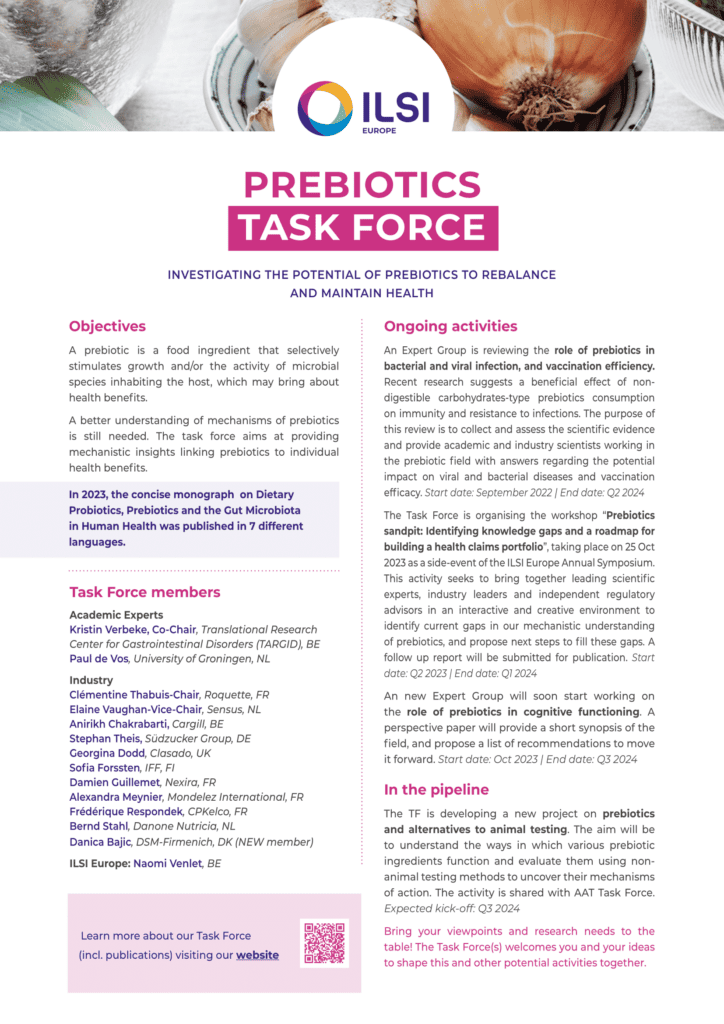
A prebiotic is a food ingredient that selectively stimulates growth and/or the activity of microbial species inhabiting the host, which may bring about health benefits. A better understanding of mechanisms of prebiotics is still needed. The task force aims at providing mechanistic insights linking prebiotics to individual health benefits.
Task Force Members
| Clémentine Thabuis-Chair | Roquette | Senior Nutrition & Health Research Manager | FR |
| Elaine Vaughan-Vice-Chair | Sensus | Scientific & Regulatory Affairs | NL |
| Kristin Verbeke, Co-Chair | Translational Research Center for Gastrointestinal Disorders (TARGID) | Researcher | BE |
| Paul de Vos | University of Groningen | Full Professor | NL |
| Annick Pollet | Cargill | Ingredient Chemistry R&D Manager | BE |
| Stephan Theis | Südzucker Group | Head of Nutrition Science | DE |
| Georgina Dodd | Clasado | R&D Senior Scientist | UK |
| Sofia Forssten | IFF | Senior Scientist | FI |
| Damien Guillemet | Nexira | Scientific Development Director | FR |
| Alexandra Meynier | Mondelez International | Nutrition Scientist | FR |
| Frédérique Respondek | CPKelco | Director Innovation | FR |
| Bernd Stahl | Danone Nutricia | Director Research & Innovation | NL |
| Danica Bajic | DSM-Firmenich | Scientist | DK |
| Naomi Venlet | ILSI Europe | Scientific Project Manager | BE |
*Scientific Advisor
For more detailed information, please contact Naomi Venlet at nvenlet@ilsieurope.be
Activity Overview
Ongoing
- Role of prebiotics in bacterial and viral infection, and vaccination efficiency
Recent research suggests a beneficial effect of nondigestible carbohydrates-type prebiotics consumption on immunity and resistance to infections. The purpose of this activity is to review and collect and assess the scientific evidence and provide academic and industry scientists working in the prebiotic field with answers regarding the potential impact on viral and bacterial diseases and vaccination efficacy.
Start date: September 2022 | End date: Q2 2024
- Prebiotics sandpit: Identifying knowledge gaps and a roadmap for building a health claims portfolio
The Task Force is organising a workshop taking place on 25 Oct 2023 as a side-event of the ILSI Europe Annual Symposium.
This activity seeks to bring together leading scientific experts, industry leaders and independent regulatory advisors in an interactive and creative environment to identify current gaps in our mechanistic understanding of prebiotics, and propose next steps to fill these gaps. A follow up report will be submitted for publication.
Start date: Q2 2023 | End date: Q1 2024
- Role of prebiotics in cognitive functioning
The Expert Group will soon start working on the role of prebiotics in cognitive functioning. A perspective paper will provide a short synopsis of the field, and propose a list of recommendations to move it forward.
Start date: Oct 2023 | End date: Q3 2024
In the pipeline
- Prebiotics and alternatives to animal testing
The TF is developing a new project on prebiotics and alternatives to animal testing. The aim will be to understand the ways in which various prebiotic ingredients function and evaluate them using nonanimal testing methods to uncover their mechanisms of action. The activity is shared with AAT Task Force.
Expected kick-off: Q3 2024
Expert Groups
Role of prebiotics in cognitive functioning: What do we know and where to go next?
Background and objectives
The aim of the activity will be to produce a perspective article that provides a short synopsis of the field, and proposes a list of recommendations to move the field forward. Specifically, it will highlight the need to perform studies in healthy participants that test the potential “rescuing” effects of prebiotics under conditions where cognition may be transiently compromised. Ultimately, such studies would allow better estimation of the magnitude of effects of prebiotics, since current studies largely yield null findings.
Output
- Perspective paper
- Presentation at FENS 2023
Expert group members
| Boushra Dalile | Translational Research Center for Gastrointestinal Disorders - Targid | Researcher | BE |
| Yannick Vermeiren | Wageningen University | Assistant Professor | NL |
| Kathrin Cohen Kadosh | University of Surrey | Researcher | UK |
| Harriet Schellekens | University College Cork | Lecturer Anatomy & Neuroscience | UK |
| Simon McArthur | Queen Mary University of London | Senior Lecturer in Neuroscience & Pharmacology | UK |
| Robert-Jan Brummer | Örebro University | Professor | SE |
| Neil Boyle | University of Leeds | Research Fellow | UK |
| Anirikh Chakrabarti | Cargill | Microbiome Program Lead | BE |
| Veerle Dam | Sensus | Health Science and Regulatory Affairs Specialist | NL |
| Frédérique Respondek | CPKelco | Director Innovation | FR |
| Yoghatama Cindya Zanzer | Beneo | Manager Nutrition Science | BE |
| Georgina Dodd | Clasado | R&D Senior Scientist | UK |
| Naomi Venlet | ILSI Europe | Scientific Project Manager | BE |
Role of prebiotics in bacterial and viral infection, and vaccination efficiency
Background and Objectives
Recent research, including human clinical research, gut microbiota effects and resultant metabolites, suggests a beneficial effect of non-digestible carbohydrates-type prebiotics consumption on immunity and resistance to infections. In this context, the purpose of this review is to collect and assess the scientific evidence and provide academic and industry scientists working in the prebiotic field with answers regarding the potential impact on viral and bacterial diseases and vaccination efficacy. The review will give the current status for prebioticsimpact on infections, both prevention or recovery,and in supporting vaccination efficacy, for academicsand industry scientists in this field. Especially in the SARS-Cov2 crisis, such a review may offer guidance to academia and industry to propose research or to manufacture food products with prebiotics for healthier diets to support immunity in vulnerable individuals.
Output
- Systematic review
- Presentation at FENS 2023
Expert Group Members
| Paul de Vos – Chair | University Medical Center Groningen (UMCG) | Professor | NL |
| Elaine Vaughan – Vice-Chair | Sensus | Scientific & Regulatory Affairs | NL |
| Hediye Arioz Tunc | University of Southampton | Postgraduate Research Student | UK |
| Alissa Cait | Malaghan Institute of Medical Research | Postdoctoral Researcher | NZ |
| Philip Calder | University of Southampton | Professor of Nutritional Immunology, Head Human Development & Health | UK |
| Lucien Harthoorn | Clasado | Director Research & Development | UK |
| Olivier Gasser | Malaghan Institute of Medical Research | Translational Immunology | NZ |
| Damien Guillemet | Nexira | Scientific Development Director | FR |
| Daniel James | University of Reading | UK | |
| Anna Lubkowska | Pomeranian Medical University in Szczecin | Head of Functional Diagnostics and Physical Medicine | PL |
| Alexandra Meynier | Mondelēz International | Nutrition Scientist | FR |
| Weronika Ratajczak | Pomeranian Medical University in Szczecin | Chair of Functional Diagnostics and Physical Medicine | PL |
| Frédérique Respondek | CPKELCO | Director Scientific Regulatory Affairs | FR |
| Clémentine Thabuis | Roquette | Nutrition Research Manager | FR |
| Stephan Theis | Südzucker Group | Head of Nutrition Science | DE |
| Gemma Walton | University of Reading | Associate Professor | UK |
| Naomi Venlet | ILSI Europe | Scientific Project Manager | BE |
Publications
Monographs
Dietary Probiotics, Prebiotics and the Gut Microbiota in Human Health
2022
Commissioned by the Prebiotics and Probiotics Task Forces.
Probiotics, Prebiotics and the Gut Microbiota
2013
ILSI Europe Concise Monograph. 2013:1-32. Commissioned by the Prebiotics and Probiotics Task Forces. Translation available in Portuguese and Japanese.
- To download the English version, click here.
- To download the Portuguese version, click here.
- To download the French version, click here.
- To download the Spanish version, click here.
- To download the Slovak version, click here.
- To download the Japanese version, click here.
- To download the Chinese version, click here.
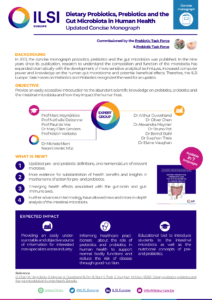
Click on the image below to download the one-pager summary.
Commissioned by the Prebiotics and Probiotics Task Forces.
[post_title] => Dietary Probiotics, Prebiotics and the Gut Microbiota in Human Health [post_excerpt] => [post_status] => publish [comment_status] => closed [ping_status] => closed [post_password] => [post_name] => dietary-probiotics-prebiotics-and-the-gut-microbiota-in-human-health [to_ping] => [pinged] => [post_modified] => 2023-02-06 13:36:16 [post_modified_gmt] => 2023-02-06 13:36:16 [post_content_filtered] => [post_parent] => 0 [guid] => https://ilsi.eu/?post_type=publication&p=10626 [menu_order] => 0 [post_type] => publication [post_mime_type] => [comment_count] => 0 [filter] => raw ) [1] => WP_Post Object ( [ID] => 557 [post_author] => 12 [post_date] => 2016-05-10 10:36:41 [post_date_gmt] => 2016-05-10 10:36:41 [post_content] => [post_title] => Probiotics, Prebiotics and the Gut Microbiota [post_excerpt] => [post_status] => publish [comment_status] => closed [ping_status] => closed [post_password] => [post_name] => probiotics-prebiotics-and-the-gut-microbiota [to_ping] => [pinged] => [post_modified] => 2022-08-19 08:29:36 [post_modified_gmt] => 2022-08-19 08:29:36 [post_content_filtered] => [post_parent] => 0 [guid] => https://ilsi.org/europe/?post_type=publication&p=557 [menu_order] => 0 [post_type] => publication [post_mime_type] => [comment_count] => 0 [filter] => raw ) ) [post_count] => 2 [current_post] => -1 [before_loop] => [in_the_loop] => [post] => WP_Post Object ( [ID] => 10626 [post_author] => 24 [post_date] => 2022-04-06 14:11:57 [post_date_gmt] => 2022-04-06 14:11:57 [post_content] =>Citation: https://doi.org/10.5281/zenodo.6394212
The scientific understanding of prebiotic and probiotic mechanisms has grown substantially in recent years. Although effects are often strain and product specific, some prebiotic and probiotic benefits may be driven by common, shared mechanisms and may therefore be generalizable. The use of emerging physiological and analytical tools in a multidisciplinary research setting will enable the elucidation of further mechanisms. In this way, it will be possible to improve the understanding of prebiotic, probiotic and synbiotic health effects. Based on recent sound scientific evidence, the monograph is a valuable reference work, aimed at informing a wide audience about the intestinal microbiota and the prebiotic and probiotic nutritional concepts.
- To download the English version, click here.
- To download the Portuguese version, click here.
- To download the French version, click here.
- To download the Spanish version, click here.
- To download the Slovak version, click here.
- To download the Japanese version, click here.
- To download the Chinese version, click here.
Click on the image below to download the one-pager summary.
Commissioned by the Prebiotics and Probiotics Task Forces.
[post_title] => Dietary Probiotics, Prebiotics and the Gut Microbiota in Human Health [post_excerpt] => [post_status] => publish [comment_status] => closed [ping_status] => closed [post_password] => [post_name] => dietary-probiotics-prebiotics-and-the-gut-microbiota-in-human-health [to_ping] => [pinged] => [post_modified] => 2023-02-06 13:36:16 [post_modified_gmt] => 2023-02-06 13:36:16 [post_content_filtered] => [post_parent] => 0 [guid] => https://ilsi.eu/?post_type=publication&p=10626 [menu_order] => 0 [post_type] => publication [post_mime_type] => [comment_count] => 0 [filter] => raw ) [comment_count] => 0 [current_comment] => -1 [found_posts] => 2 [max_num_pages] => 1 [max_num_comment_pages] => 0 [is_single] => [is_preview] => [is_page] => [is_archive] => 1 [is_date] => [is_year] => [is_month] => [is_day] => [is_time] => [is_author] => [is_category] => [is_tag] => [is_tax] => 1 [is_search] => [is_feed] => [is_comment_feed] => [is_trackback] => [is_home] => [is_privacy_policy] => [is_404] => [is_embed] => [is_paged] => [is_admin] => [is_attachment] => [is_singular] => [is_robots] => [is_favicon] => [is_posts_page] => [is_post_type_archive] => [query_vars_hash:WP_Query:private] => 42d1f5f6f476a29bfc74495d1a9df497 [query_vars_changed:WP_Query:private] => [thumbnails_cached] => [allow_query_attachment_by_filename:protected] => [stopwords:WP_Query:private] => [compat_fields:WP_Query:private] => Array ( [0] => query_vars_hash [1] => query_vars_changed ) [compat_methods:WP_Query:private] => Array ( [0] => init_query_flags [1] => parse_tax_query ) )Multimedia
Introductory video
One-Pager
Completed Expert Groups
Overview of completed activities
- Prediction of individual responses to prebiotics and probiotics intervention (collaboration with Probiotics Task Force)
- Understanding the Relationship Between the Molecular Structure and the Effects of Prebiotic Compounds on Microbiota and its Metabolites
- Joint nutrition cluster activity on ‘mechanistic insights into the gut-brain axis' in collaboration with Early Nutrition and Long-Term Health; Health Benefit Assessment of Foods; Nutrition, Immunity & Inflammation; Nutrition & Brain Health; and Probiotics Task Forces
- Updated concise monograph - Dietary Probiotics, Prebiotics and the Gut Microbiota in Human Health (collaboration with Probiotics Task Force)
- Revealing the Mechanistic Role in Human Physiology and Beneficial Aspects of Short Chain Fatty Acid (SCFA) Production in the Gastro-Intestinal Tract (GIT)