Food Contaminants

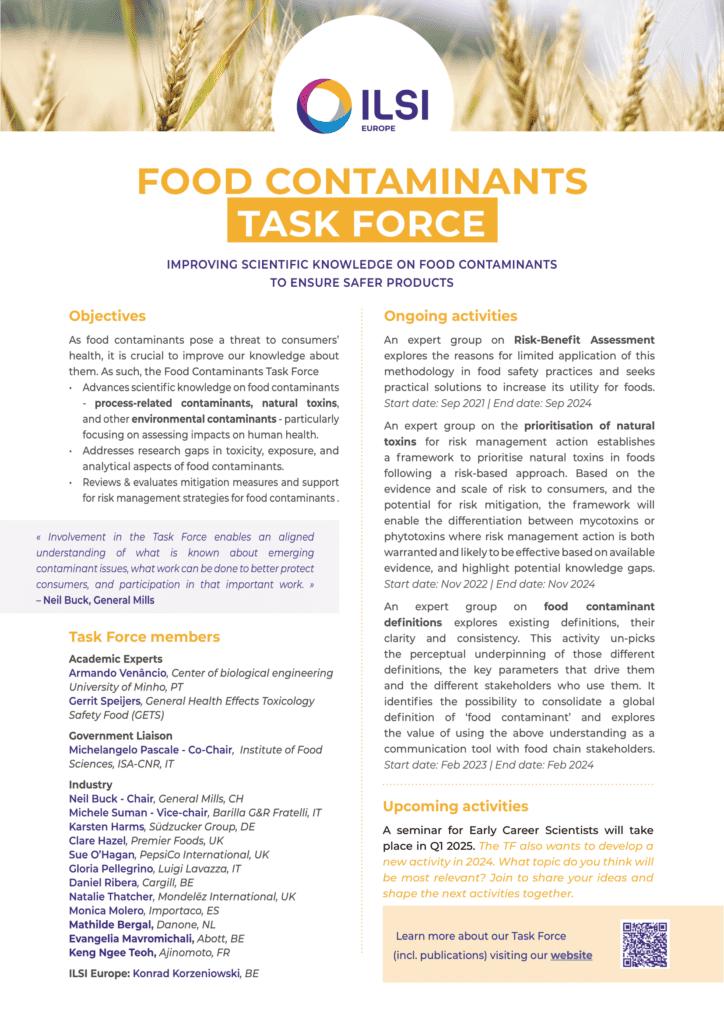
Food Contaminants

Improving scientific knowledge on food contaminants to ensure safer products

Task Force Information

Objectives and list of Task Force
members

Contact Information

Contact details in case you have specific questions

Activity Overview

Overview of ongoing and upcoming activities

Expert Groups

Objectives, output and list of experts involved in each activity

Publications

List of publications of this
Task Force

Multimedia

Links to Task Force related documents, recordings and much more...

Completed Expert Groups

Details including experts involved of each activity

Task Force Information

Objectives

Food contaminants present a serious risk to consumer health. Enhancing our understanding of them is essential. The Task Force focuses on:

  • Advancing scientific knowledge on various contaminants, particularly assessing their impact on human health.
  • Addressing research gaps in toxicity, exposure, and analytical aspects.
  • Reviewing mitigation measures and supporting risk management strategies.

Task Force Members

WP DataTables

* Scientific Advisors

Contact Information

For more detailed information, please contact Konrad Korzeniowski at kkorzeniowski@ilsieurope.be

Activity Overview

Ongoing

- Update on Risk-Benefit Assessment of Foods: Approaches to Facilitate Application

An expert group on risk-benefits assessment of foods explores the reasons for limited application and seek practical solutions to increase the utility of this methodology in foods.

Start: Sep 2021 - End: Nov 2025

- Unintentional Substances in Food: Rapid Risk Assessment to inform Risk Management

As there is no harmonized approach between Food Businesses and other stakeholders on how to perform and communicate a rapid risk assessment, a toolkit will be proposed and provide a systematic approach for risk analysis of incidents, discussing the degree of uncertainties and will be informed by existing scientific guidancesand practical experience of the participants. Risk communication will also be addressed.

Start date: March 2025 - End date: Feb 2027

- Clarifying the Current Understanding of the Human Health Risk of Per-  and Polyfluoroalkyl Substances (PFAS) in Food and Drinking Water to Enable Science-Based Communication and Risk Management

The research group is currently working on a systematic review of existing publications addressing the aspects of the current chemical grouping approaches for risk assessment to help understand whether it is appropriate for all PFAS to be effectively grouped together for risk management purposes, while also considering the sources and uses of these substances across food supply chains.

Start date: February 2026 - End date: July 2027

In the Pipeline

- Guidance on Contaminant Management for Food Business Operators

Expert Groups

Update on Risk-Benefit Assessment of foods: approaches to facilitate application

Background and Objectives

All foods contain chemical and biological impurities some of which may be viewed as contaminants of toxicological or microbiological relevance, depending on the definition used. Classical risk assessment does not reconcile the benefit to health of the food against the potential effects of the contaminants or the impact of mitigation measures that may be applied to reduce contaminants. A contaminant-centric view of a food can result in an incomplete understanding of the net health benefits of food by groups such as policy makers.

As such, methods for the comparison between benefits and risks have been developed, including the publication of guidance materials. Despite the availability of guidance, there have been a limited number of examples of risk-benefit analysis being used as an input for the risk management of foods by food safety agencies.

Output

This activity will review the evolution and application of risk-benefit assessment since its infancy, and thereby understand:

- Why risk-benefit assessment has not been more widely applied by food safety agencies in Europe?
- What are the available applications of RBA since the publication of guidance and what are the lessons learned?
- Whether existing guidance can be amended to improve applicability?
- The above learnings will be tested via a limited number of worked examples and summarized in a peer-reviewed publication.

Expert Group Members


WP DataTables

Unintentional Substances in Food: Rapid Risk Assessment to inform Risk Management.

Background and objectives

Food ‘incidents’ occur when there is an unexpected presence of a substance within food that has been produced leading to potential safety concern, either because of regulatory non-compliance or the hazard associated with the substance. As there is no harmonized approach between Food Businesses and other stakeholders on how to perform and communicate a rapid risk assessment, a toolkit will be proposed and provide a systematic approach for risk analysis of incidents, discussing the degree of uncertainties and will be informed by existing scientific guidancesand practical experience of the participants. Risk communication will also be addressed.

Output

The output will be a toolkit for assessing and communicating health risks associated with food safety incidents (contaminants, residues, ingredients). The toolkit will provide a systematic approach to exposure assessment, risk characterization, and risk assessment, and will be informed by existing scientific guidance and practical experience of the participants.

WP DataTables

Clarifying the Current Understanding of the Human Health Risk of Per- and Polyfluoroalkyl Substances (PFAS) in Food and Drinking Water to Enable Science-Based Communication and Risk Management

Background and objectives

For a chemical class as diverse as PFAS, a scientifically rigorous approach to risk assessment is needed, and effective communication of uncertainties and data limitations is required. A systematic review of existing publications addressing the aspects of the current chemical grouping approaches for risk assessment would help understand whether it is appropriate for all PFAS to be effectively grouped together for risk management purposes, while also considering the sources and uses of these substances across food supply chains. This would allow for a holistic understanding of hazard and risk to inform a proportionate approach to risk management to maximize the impact of controls for the consumer.

Output

This highly complex and high-profile topic raises questions and challenges in terms of how best to summarize and communicate knowledge for stakeholders. A literature review of the different PFAS families, their toxicological profile and relative potency, and their environmental fate would help assess whether they should be considered for the purpose of mitigation efforts as a number of sub-groups or as a single chemical group. Publications and approaches available to assess PFAS mixtures will also be reviewed, considering relative potency when data are available and sufficiently robust. This work will provide a comprehensive and factual overview of the scientific information on this subject, show the challenges that remain, the avenues of research and propose recommendations for prioritization of risk . Included in the activity would be:

  • A systematic review of existing publications (to be carried out by EG with support from an external specialist if needed)
  • A draft a summary of the different views on hazard and risk assessment of PFAS
  • A proposal for methodological recommendations on how to manage and/or prioritize PFAS in a proportionate manner according to food and drinking water regulations

WP DataTables

Publications

All Publications

Masked Mycotoxins: A Review

Molecular Nutrition and Food Research. 2013;57(1):165-186. The aim of this review is to give a comprehensive overview of the current knowledge on plant metabolites of mycotoxins, also called masked mycotoxins.

Read more

WP_Query Object
(
    [query] => Array
        (
            [post_type] => publication
            [posts_per_page] => 5
            [type] => 
            [area] => 
            [committee] => Process Related Compounds and Natural Toxins
            [authors] => 
            [showtitle] => 
            [meta_query] => Array
                (
                    [relation] => AND
                )

            [tax_query] => Array
                (
                    [0] => Array
                        (
                            [taxonomy] => ilsi_committee
                            [field] => name
                            [terms] => Process Related Compounds and Natural Toxins
                        )

                )

            [paged] => 3
            [meta_key] => _ilsi_date
            [orderby] => meta_value
            [order] => DESC
        )

    [query_vars] => Array
        (
            [post_type] => publication
            [posts_per_page] => 5
            [type] => 
            [area] => 
            [committee] => Process Related Compounds and Natural Toxins
            [authors] => 
            [showtitle] => 
            [meta_query] => Array
                (
                    [relation] => AND
                )

            [tax_query] => Array
                (
                    [0] => Array
                        (
                            [taxonomy] => ilsi_committee
                            [field] => name
                            [terms] => Process Related Compounds and Natural Toxins
                        )

                )

            [paged] => 3
            [meta_key] => _ilsi_date
            [orderby] => meta_value
            [order] => DESC
            [error] => 
            [m] => 
            [p] => 0
            [post_parent] => 
            [subpost] => 
            [subpost_id] => 
            [attachment] => 
            [attachment_id] => 0
            [name] => 
            [pagename] => 
            [page_id] => 0
            [second] => 
            [minute] => 
            [hour] => 
            [day] => 0
            [monthnum] => 0
            [year] => 0
            [w] => 0
            [category_name] => 
            [tag] => 
            [cat] => 
            [tag_id] => 
            [author] => 
            [author_name] => 
            [feed] => 
            [tb] => 
            [meta_value] => 
            [preview] => 
            [s] => 
            [sentence] => 
            [title] => 
            [fields] => all
            [menu_order] => 
             => 
            [category__in] => Array
                (
                )

            [category__not_in] => Array
                (
                )

            [category__and] => Array
                (
                )

            [post__in] => Array
                (
                )

            [post__not_in] => Array
                (
                )

            [post_name__in] => Array
                (
                )

            [tag__in] => Array
                (
                )

            [tag__not_in] => Array
                (
                )

            [tag__and] => Array
                (
                )

            [tag_slug__in] => Array
                (
                )

            [tag_slug__and] => Array
                (
                )

            [post_parent__in] => Array
                (
                )

            [post_parent__not_in] => Array
                (
                )

            [author__in] => Array
                (
                )

            [author__not_in] => Array
                (
                )

            [search_columns] => Array
                (
                )

            [ignore_sticky_posts] => 
            [suppress_filters] => 
            [cache_results] => 1
            [update_post_term_cache] => 1
            [update_menu_item_cache] => 
            [lazy_load_term_meta] => 1
            [update_post_meta_cache] => 1
            [nopaging] => 
            [comments_per_page] => 50
            [no_found_rows] => 
            [taxonomy] => ilsi_committee
            [term_id] => Process Related Compounds and Natural Toxins
        )

    [tax_query] => WP_Tax_Query Object
        (
            [queries] => Array
                (
                    [0] => Array
                        (
                            [taxonomy] => ilsi_committee
                            [terms] => Array
                                (
                                    [0] => Process Related Compounds and Natural Toxins
                                )

                            [field] => name
                            [operator] => IN
                            [include_children] => 1
                        )

                )

            [relation] => AND
            [table_aliases:protected] => Array
                (
                    [0] => wp_3_term_relationships
                )

            [queried_terms] => Array
                (
                    [ilsi_committee] => Array
                        (
                            [terms] => Array
                                (
                                    [0] => Process Related Compounds and Natural Toxins
                                )

                            [field] => name
                        )

                )

            [primary_table] => wp_3_posts
            [primary_id_column] => ID
        )

    [meta_query] => WP_Meta_Query Object
        (
            [queries] => Array
                (
                    [0] => Array
                        (
                            [key] => _ilsi_date
                        )

                    [relation] => OR
                )

            [relation] => AND
            [meta_table] => wp_3_postmeta
            [meta_id_column] => post_id
            [primary_table] => wp_3_posts
            [primary_id_column] => ID
            [table_aliases:protected] => Array
                (
                    [0] => wp_3_postmeta
                )

            [clauses:protected] => Array
                (
                    [wp_3_postmeta] => Array
                        (
                            [key] => _ilsi_date
                            [compare] => =
                            [compare_key] => =
                            [alias] => wp_3_postmeta
                            [cast] => CHAR
                        )

                )

            [has_or_relation:protected] => 
        )

    [date_query] => 
    [request] => SELECT SQL_CALC_FOUND_ROWS  wp_3_posts.ID
					 FROM wp_3_posts  LEFT JOIN wp_3_term_relationships ON (wp_3_posts.ID = wp_3_term_relationships.object_id) INNER JOIN wp_3_postmeta ON ( wp_3_posts.ID = wp_3_postmeta.post_id )
					 WHERE 1=1  AND ( 
  wp_3_term_relationships.term_taxonomy_id IN (23)
) AND ( 
  wp_3_postmeta.meta_key = '_ilsi_date'
) AND ((wp_3_posts.post_type = 'publication' AND (wp_3_posts.post_status = 'publish' OR wp_3_posts.post_status = 'acf-disabled')))
					 GROUP BY wp_3_posts.ID
					 ORDER BY wp_3_postmeta.meta_value DESC
					 LIMIT 10, 5
    [posts] => Array
        (
            [0] => WP_Post Object
                (
                    [ID] => 550
                    [post_author] => 12
                    [post_date] => 2016-05-10 10:13:53
                    [post_date_gmt] => 2016-05-10 10:13:53
                    [post_content] => 
                    [post_title] => Fatty Acid Esters of Monochloropropanediol (MCPD) and Glycidol in Refined Edible Oils
                    [post_excerpt] => 
                    [post_status] => publish
                    [comment_status] => closed
                    [ping_status] => closed
                    [post_password] => 
                    [post_name] => fatty-acid-esters-of-monochloropropanediol-mcpd-and-glycidol-in-refined-edible-oils
                    [to_ping] => 
                    [pinged] => 
                    [post_modified] => 2016-12-12 09:28:16
                    [post_modified_gmt] => 2016-12-12 09:28:16
                    [post_content_filtered] => 
                    [post_parent] => 0
                    [guid] => https://ilsi.org/europe/?post_type=publication&p=550
                    [menu_order] => 0
                    [post_type] => publication
                    [post_mime_type] => 
                    [comment_count] => 0
                    [filter] => raw
                )

            [1] => WP_Post Object
                (
                    [ID] => 1025
                    [post_author] => 12
                    [post_date] => 2016-05-21 14:37:48
                    [post_date_gmt] => 2016-05-21 14:37:48
                    [post_content] => 
                    [post_title] => Masked Mycotoxins: A Review
                    [post_excerpt] => 
                    [post_status] => publish
                    [comment_status] => closed
                    [ping_status] => closed
                    [post_password] => 
                    [post_name] => masked-mycotoxins-a-review
                    [to_ping] => 
                    [pinged] => 
                    [post_modified] => 2016-06-22 18:30:15
                    [post_modified_gmt] => 2016-06-22 18:30:15
                    [post_content_filtered] => 
                    [post_parent] => 0
                    [guid] => https://ilsi.org/europe/?post_type=publication&p=1025
                    [menu_order] => 0
                    [post_type] => publication
                    [post_mime_type] => 
                    [comment_count] => 0
                    [filter] => raw
                )

            [2] => WP_Post Object
                (
                    [ID] => 2179
                    [post_author] => 12
                    [post_date] => 2016-06-28 21:34:55
                    [post_date_gmt] => 2016-06-28 21:34:55
                    [post_content] => 
                    [post_title] => Evaluation of Agronomic Practices for Mitigation of Natural Toxins
                    [post_excerpt] => 
                    [post_status] => publish
                    [comment_status] => closed
                    [ping_status] => closed
                    [post_password] => 
                    [post_name] => evaluation-of-agronomic-practices-for-mitigation-of-natural-toxins
                    [to_ping] => 
                    [pinged] => 
                    [post_modified] => 2016-06-28 21:34:55
                    [post_modified_gmt] => 2016-06-28 21:34:55
                    [post_content_filtered] => 
                    [post_parent] => 0
                    [guid] => http://ilsi.eu/?post_type=publication&p=2179
                    [menu_order] => 0
                    [post_type] => publication
                    [post_mime_type] => 
                    [comment_count] => 0
                    [filter] => raw
                )

            [3] => WP_Post Object
                (
                    [ID] => 1792
                    [post_author] => 12
                    [post_date] => 2016-06-21 16:45:45
                    [post_date_gmt] => 2016-06-21 16:45:45
                    [post_content] => 
                    [post_title] => 3-MCPD Esters in Food Products Summary Report
                    [post_excerpt] => 
                    [post_status] => publish
                    [comment_status] => closed
                    [ping_status] => closed
                    [post_password] => 
                    [post_name] => 3-mcpd-esters-in-food-products-summary-report
                    [to_ping] => 
                    [pinged] => 
                    [post_modified] => 2016-06-21 16:45:45
                    [post_modified_gmt] => 2016-06-21 16:45:45
                    [post_content_filtered] => 
                    [post_parent] => 0
                    [guid] => http://ilsi.eu/?post_type=publication&p=1792
                    [menu_order] => 0
                    [post_type] => publication
                    [post_mime_type] => 
                    [comment_count] => 0
                    [filter] => raw
                )

            [4] => WP_Post Object
                (
                    [ID] => 1897
                    [post_author] => 12
                    [post_date] => 2016-06-24 18:35:47
                    [post_date_gmt] => 2016-06-24 18:35:47
                    [post_content] => 
                    [post_title] => Ochratoxin A in Food: Recent Developments and Significance
                    [post_excerpt] => 
                    [post_status] => publish
                    [comment_status] => closed
                    [ping_status] => closed
                    [post_password] => 
                    [post_name] => ochratoxin-a-in-food-recent-developments-and-significance
                    [to_ping] => 
                    [pinged] => 
                    [post_modified] => 2016-06-24 18:35:47
                    [post_modified_gmt] => 2016-06-24 18:35:47
                    [post_content_filtered] => 
                    [post_parent] => 0
                    [guid] => http://ilsi.eu/?post_type=publication&p=1897
                    [menu_order] => 0
                    [post_type] => publication
                    [post_mime_type] => 
                    [comment_count] => 0
                    [filter] => raw
                )

        )

    [post_count] => 5
    [current_post] => -1
    [before_loop] => 
    [in_the_loop] => 
    [post] => WP_Post Object
        (
            [ID] => 550
            [post_author] => 12
            [post_date] => 2016-05-10 10:13:53
            [post_date_gmt] => 2016-05-10 10:13:53
            [post_content] => 
            [post_title] => Fatty Acid Esters of Monochloropropanediol (MCPD) and Glycidol in Refined Edible Oils
            [post_excerpt] => 
            [post_status] => publish
            [comment_status] => closed
            [ping_status] => closed
            [post_password] => 
            [post_name] => fatty-acid-esters-of-monochloropropanediol-mcpd-and-glycidol-in-refined-edible-oils
            [to_ping] => 
            [pinged] => 
            [post_modified] => 2016-12-12 09:28:16
            [post_modified_gmt] => 2016-12-12 09:28:16
            [post_content_filtered] => 
            [post_parent] => 0
            [guid] => https://ilsi.org/europe/?post_type=publication&p=550
            [menu_order] => 0
            [post_type] => publication
            [post_mime_type] => 
            [comment_count] => 0
            [filter] => raw
        )

    [comment_count] => 0
    [current_comment] => -1
    [found_posts] => 15
    [max_num_pages] => 3
    [max_num_comment_pages] => 0
    [is_single] => 
    [is_preview] => 
    [is_page] => 
    [is_archive] => 1
    [is_date] => 
    [is_year] => 
    [is_month] => 
    [is_day] => 
    [is_time] => 
    [is_author] => 
    [is_category] => 
    [is_tag] => 
    [is_tax] => 1
    [is_search] => 
    [is_feed] => 
    [is_comment_feed] => 
    [is_trackback] => 
    [is_home] => 
    [is_privacy_policy] => 
    [is_404] => 
    [is_embed] => 
    [is_paged] => 1
    [is_admin] => 
    [is_attachment] => 
    [is_singular] => 
    [is_robots] => 
    [is_favicon] => 
    [is_posts_page] => 
    [is_post_type_archive] => 
    [query_vars_hash:WP_Query:private] => be6bbcce32a106835996b17d1e650f90
    [query_vars_changed:WP_Query:private] => 
    [thumbnails_cached] => 
    [allow_query_attachment_by_filename:protected] => 
    [stopwords:WP_Query:private] => 
    [compat_fields:WP_Query:private] => Array
        (
            [0] => query_vars_hash
            [1] => query_vars_changed
        )

    [compat_methods:WP_Query:private] => Array
        (
            [0] => init_query_flags
            [1] => parse_tax_query
        )

    [query_cache_key:WP_Query:private] => wp_query:a7ca2a0a7cc8a7daf85bf1f9cb17390b:0.17340000 17767354580.11256700 1776735458
)

Multimedia

Completed Expert Groups