
Task Force Information
Objectives
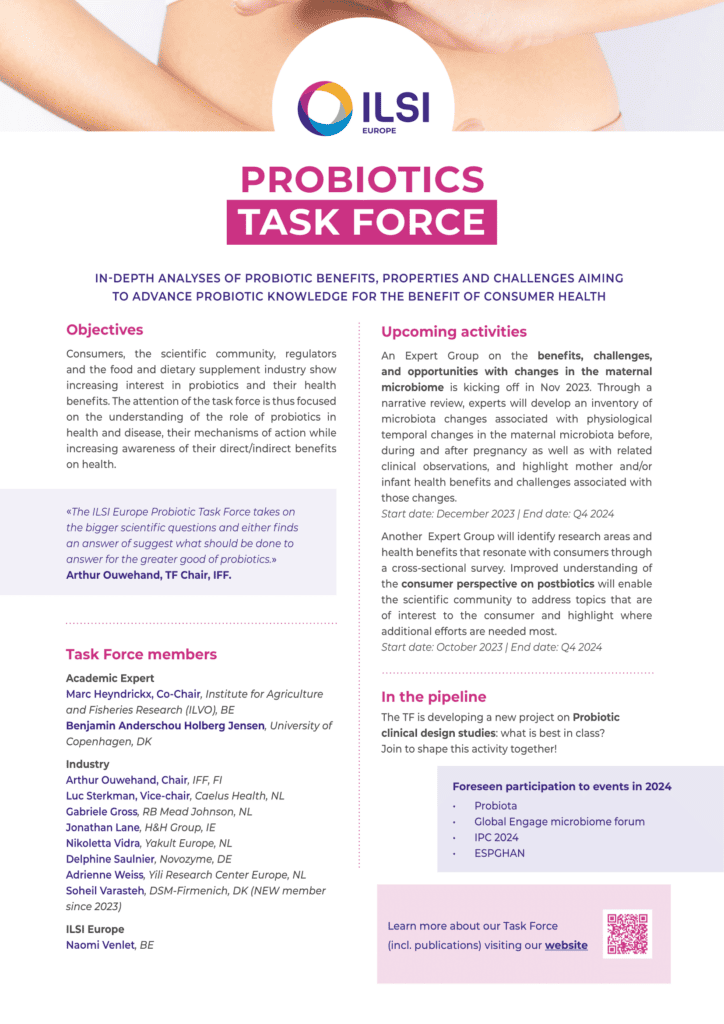
Consumers, the scientific community, regulators and the food and dietary supplement industry show increasing interest in probiotics and their health benefits. The attention of the task force is thus focused on the understanding of the role of probiotics in health and disease, their mechanisms of action while increasing awareness of their direct/indirect benefits on health.
Task Force Members
| Arthur Ouwehand – Chair | International Flavors & Fragrances (IFF) | R&D Group Manager | FI |
| Luc Sterkman – Vice-Chair | Caelus Health | CEO | NL |
| Marc Heyndrickx* – Co-Chair | Institute for Agricultural and Fisheries Research (ILVO) | Scientific Director | BE |
| Vicenta Garcia Campayo | Principal Scientist | Cargill | US |
| Gabriele Gross | Mead Johnson Nutrition / Reckitt | Head of Emerging Sciences | NL |
| Benjamin Anderschou Holbech Jensen* | University of Copenhagen | Assist. Professor, Head of Nutritional Immunology | DK |
| Jonathan Lane | H&H Group | Senior Manager, Global Research | IE |
| Soheil Varasteh | DSM-Firmenich | Translational Science Lead | DK |
| Delphine Saulnier | Novonesis | Science Manager | DE |
| Nikoletta Vidra | Yakult Europe | BE | |
| Adrienne Weiss | Yili Innovation Center Europe | Innovation Project Leader | NL |
| Naomi Venlet | ILSI Europe | Scientific Project Manager | BE |
* Scientific Advisors
Contact Information
For more detailed information, please contact Naomi Venlet at nvenlet@ilsieurope.be
Activity Overview
Upcoming activities
- Benefits, challenges, and opportunities with changes in the maternal microbiome
Through a narrative review, experts will develop an inventory of microbiota changes associated with physiological temporal changes in the maternal microbiota before, during and after pregnancy as well as with related clinical observations, and highlight mother and/or infant health benefits and challenges associated with those changes.
Start date: December 2023 | End date: Q4 2024
- Consumer perspective on postbiotics
The Expert Group will identify research areas and health benefits that resonate with consumers through a cross-sectional survey.
Start date: October 2023 | End date: Q4 2024
In the pipeline
- Probiotic clinical design studies
Join to shape this activity together!
Expert Groups
Benefits, challenges, and opportunities with changes in the maternal microbiome before and during pregnancy
Background and objectives
During pregnancy, especially during the third trimester, the maternal microbiota is undergoing considerable changes in the gut, the vagina and, as recently shown, the endometrium. Interestingly, the maternal microbiome has now emerged as an important factor for a healthy pregnancy as well as a cause of pregnancy-related health issues e.g. preterm birth. Indeed, emerging research has started to link microbial dysbiosis and specific microbial populations with pregnancy complications. Thus, it is important to understand the context of physiological temporal microbial changes during pregnancy and mechanisms by which these changes can impact health outcomes. Furthermore, the use of probiotics during pregnancy is not a standard practice; however, given the importance of the microbiota for various health outcomes, it is crucial to better understand maternal microbiota changes, natural or induced, before and during pregnancy, their impact on maternal health and underlying mechanisms of action, as well the potential role of probiotics to optimise maternal health outcomes based on these insights. The activity will detail the mechanistic consequences of maternal microbiota changes, and discuss early observations from probiotic clinical studies, to identify opportunities for optimised use ofprobiotics during pregnancy. The experts will identify and review
Output
Narrative review
Expert group members
| Gabriele Gross | Reckitt Benckiser/Mead Johnson Nutrition | Principal Scientist / Project Leader | NL |
| Jonathan Lane | H&H group | Associate Director | IE |
| Nikoletta Vidra | Yakult Europe | BE | |
| Adrienne Weiss | Yili Innovation Center Europe | Innovation Project Leader | NL |
| Maria Carmen Collado | Spanish National Research Council | ES | |
| Flavia Indrio | University of Bar | Associate Professor | ES |
| Sarah Lebeer | University of Antwerp | Research Professor | BE |
| Yvan Vandenplas | University of Brussels | Professor | BE |
| Naomi Venlet | ILSI Europe | Scientific Project Manager | BE |
Postbiotics: consumer knowledge, understanding and gap analysis to guide future scientific research
Background and Objectives
Typically, scientific research is not based on
consumer perspective and does not resonate with the general public. This activity aims for an opposite approach: use consumer insights to guide future research. In order to identify research areas and health benefits that resonate with consumers and to address their concerns and gaps in knowledge, this expert group will conduct a cross-sectional survey to guide future scientific research. Improved understanding of the consumer perspective will enable the scientific community to address topics that are of interest to the consumer and highlight where additional efforts are needed most.
Output
- Cross-sectional survey
- Consumer information leaflet
- Peer-reviewed publication
Expert Group Members
| Renaud Mestdagh | Cargill | Senior Scientist Infant Nutrition | BE |
| Delphine Saulnier | Novonesis | Health Science Lead | DE |
| Gabriele Gross | RB Mead Johnson | Head of Emerging Sciences | NL |
| Naomi Venlet | ILSI Europe | Scientific Project Manager | BE |
Publications
Z to A
Monitoring Immune Modulation by Nutrition in the General Population: Identifying and Substantiating Effects on Human Health
2013
Human Intestinal Barrier Function in Health and Disease
2016
Clinical and Translational Gastroenterology 2016. 7, e196. Commissioned by the Probiotics Task Force.
Homeostasis of the Gut Barrier and Potential Biomarkers
2016
American Journal of Physiology – Gastrointestinal and Liver Physiology 2017; 312 (3): G171-G193. Commissioned by the Probiotics Task Force.
Guidance for Assessing the Probiotics Beneficial Effects: How to Fill the Gap
2010
Journal of Nutrition. 2010;140:S671-S721.
Dietary Probiotics, Prebiotics and the Gut Microbiota in Human Health
2022
Commissioned by the Prebiotics and Probiotics Task Forces.
- To download the English version, click here.
- To download the Portuguese version, click here.
- To download the French version, click here.
- To download the Spanish version, click here.
- To download the Slovak version, click here.
- To download the Japanese version, click here.
- To download the Chinese version, click here.
Click on the image below to download the one-pager summary.
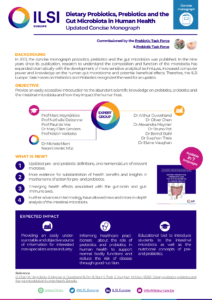
Commissioned by the Prebiotics and Probiotics Task Forces.
[post_title] => Dietary Probiotics, Prebiotics and the Gut Microbiota in Human Health [post_excerpt] => [post_status] => publish [comment_status] => closed [ping_status] => closed [post_password] => [post_name] => dietary-probiotics-prebiotics-and-the-gut-microbiota-in-human-health [to_ping] => [pinged] => [post_modified] => 2023-02-06 13:36:16 [post_modified_gmt] => 2023-02-06 13:36:16 [post_content_filtered] => [post_parent] => 0 [guid] => https://ilsi.eu/?post_type=publication&p=10626 [menu_order] => 0 [post_type] => publication [post_mime_type] => [comment_count] => 0 [filter] => raw ) ) [post_count] => 5 [current_post] => -1 [before_loop] => [in_the_loop] => [post] => WP_Post Object ( [ID] => 555 [post_author] => 12 [post_date] => 2016-05-10 10:32:04 [post_date_gmt] => 2016-05-10 10:32:04 [post_content] => [post_title] => Monitoring Immune Modulation by Nutrition in the General Population: Identifying and Substantiating Effects on Human Health [post_excerpt] => [post_status] => publish [comment_status] => closed [ping_status] => closed [post_password] => [post_name] => monitoring-immune-modulation-by-nutrition-in-the-general-population-identifying-and-substantiating-effects-on-human-health [to_ping] => [pinged] => [post_modified] => 2017-11-20 13:25:56 [post_modified_gmt] => 2017-11-20 13:25:56 [post_content_filtered] => [post_parent] => 0 [guid] => https://ilsi.org/europe/?post_type=publication&p=555 [menu_order] => 0 [post_type] => publication [post_mime_type] => [comment_count] => 0 [filter] => raw ) [comment_count] => 0 [current_comment] => -1 [found_posts] => 11 [max_num_pages] => 3 [max_num_comment_pages] => 0 [is_single] => [is_preview] => [is_page] => [is_archive] => 1 [is_date] => [is_year] => [is_month] => [is_day] => [is_time] => [is_author] => [is_category] => [is_tag] => [is_tax] => 1 [is_search] => [is_feed] => [is_comment_feed] => [is_trackback] => [is_home] => [is_privacy_policy] => [is_404] => [is_embed] => [is_paged] => 1 [is_admin] => [is_attachment] => [is_singular] => [is_robots] => [is_favicon] => [is_posts_page] => [is_post_type_archive] => [query_vars_hash:WP_Query:private] => d76c2a048643c39d5a0b98c9e0be4fa8 [query_vars_changed:WP_Query:private] => [thumbnails_cached] => [allow_query_attachment_by_filename:protected] => [stopwords:WP_Query:private] => [compat_fields:WP_Query:private] => Array ( [0] => query_vars_hash [1] => query_vars_changed ) [compat_methods:WP_Query:private] => Array ( [0] => init_query_flags [1] => parse_tax_query ) )Multimedia
Introductory video
One-Pager
Completed Expert Groups
Overview of completed activities since 2021
- Prediction of individual responses to prebiotics and probiotics intervention (collaboration Prebiotics Task Force)
- Joint nutrition cluster activity on ‘mechanistic insights into the gut-brain axis' in collaboration with Early Nutrition and Long-Term Health; Health Benefit Assessment of Foods; Nutrition, Immunity & Inflammation; Nutrition & Brain Health and Prebiotics Task Forces
- Updated concise monograph - Dietary Probiotics, Prebiotics and the Gut Microbiota in Human Health (collaboration with Probiotics Task Force)