

Why nutrition in early life matters?
Task Force Information
Objectives
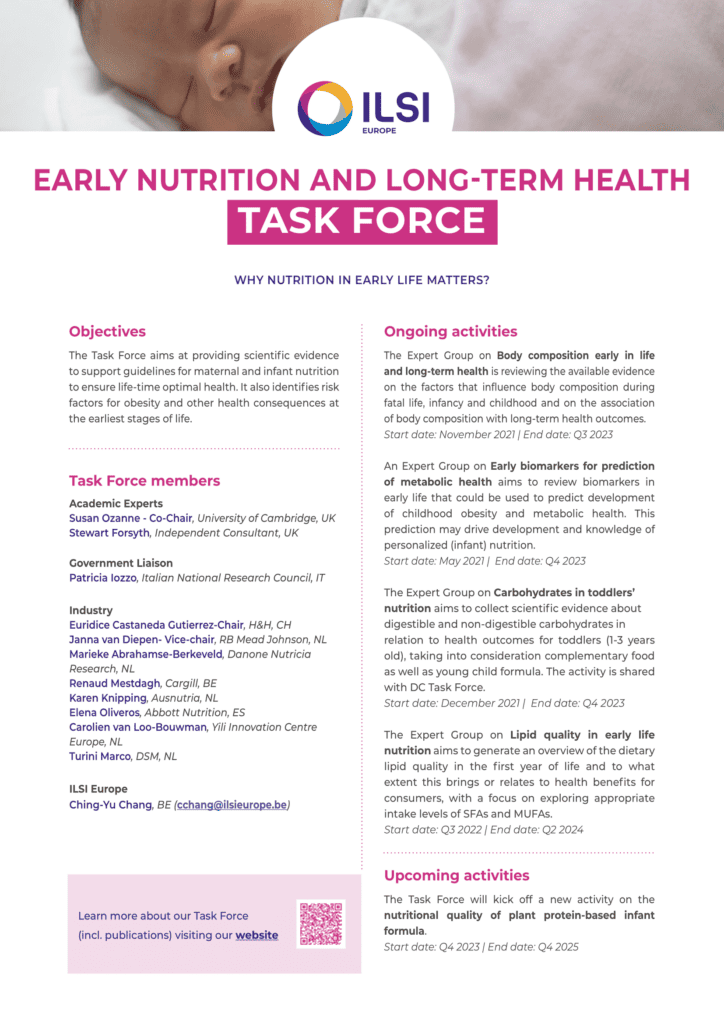
The Task Force aims at providing scientific evidence to support guidelines for maternal and infant nutrition to ensure life-time optimal health. It also identifies risk factors for obesity and other health consequences at the earliest stages of life.
Task Force Members
| Carolien van Loo-Bouwman | Yili Innovation Center Europe | Open Innovation Manager | NL |
| Euridice Castaneda Gutierrez – Chair | H&H | Science and Communication Manager | CH |
| Susan Ozanne – Co-Chair | University of Cambridge | Professor | UK |
| Janna Van Diepen - Vice-Chair | RB Mead Johnson | Principal Scientist | NL |
| Marieke Abrahamse-Berkeveld | Danone Nutricia Research | Senior Team Leader Growth & Development | NL |
| Patricia Iozzo* | Italian National Research Council | Researcher | IT |
| Karen Knipping | Ausnutria | Senior Research Scientist | NL |
| Nils Billecke | Cargill | Senior Nutrition Scientist | BE |
| Marco Turini | DSM | enior Manager in Nutrition and Health & Wellness | NL |
| Elena Oliveros | Abbott Nutrition | Senior Scientist | ES |
| Ching-Yu Chang | ILSI Europe | Scientific Project Manager | BE |
Contact Information
For more detailed information, please contact Ching-Yu Chang at cchang@ilsieurope.be
Activity Overview
Ongoing
- Early biomarkers for prediction of metabolic health
The EG aims to review biomarkers in early life that could be used to predict development of childhood obesity and metabolic health. This prediction may drive development and knowledge of personalized (infant) nutrition.
Start date: May 2021 | End date: Q4 2023
- Carbohydrates in toddlers’ nutrition
The activity aims to collect scientific evidence about digestible and non digestible carbohydrates in relation to health outcomes for toddlers (1-3 years old), taking into consideration complementary food as well as young child formula. The activity is shared with DC Task Force.
Start date: December 2021 | End date: Q4 2023
- Lipid quality in early life nutrition
The activity aims to generate an overview of the dietary lipid quality in the first year of life and to what extent this brings or relates to health benefits for consumers, with a focus on exploring appropriate intake levels of SFAs and MUFAs.
Start date: Q3 2022 | End date: Q2 2024
Upcoming
- Nutritional quality of plant protein-based infant formula
More info to come soon...
Start date: Q4 2023 | End date: Q4 2025
Expert Groups
Early biomarkers for prediction of metabolic health
Background and Objectives
The aim of the activity is to review biomarkers in early life that could be used to predict development of childhood obesity and metabolic health. The activity will focus on invasive and non-invasive, perinatal and postnatal biomarkers. This activity aims to:
- Summarise the current evidence for early life (perinatal and postnatal) biomarkers that are able to predict childhood obesity and related metabolic health.
- Emphasise relevance of combining conventional predictive markers (e.g. early weight gain) with novel applications of metabolomics, epigenetics and microbiota profiling. It will help to more accurately and effectively identify infants at risk to develop obesity.
- Emphasise importance of validity and reliability of identified biomarkers for application of such biomarkers in (daily) practice.
Output
The highlighted (recent) findings in the development of biomarkers for early life prediction of metabolic health could be used to guide risk prediction and stratification. This prediction may drive development and knowledge of personalised (infant) nutrition to reduce the risk of childhood obesity. Researchers should become aware of the urgency to develop and validate new predictive biomarkers that are both easily detectable and responsive to nutritional interventions.
Expert Group Members
| Romy Gaillard – Chair | Erasmus University Rotterdam | Professor | NL |
| Janna van Diepen – Vice Chair | Reckitt Benckiser/Mead Johnson Nutrition | Senior Scientist | NL |
| Marieke Abrahamse-Berkeveld | Danone Nutricia Research | Senior Team Leader Growth & Development | NL |
| Sophia Blaauwendraad | Erasmus University Rotterdam | Researcher | NL |
| Marco Brandimonte-Hernández | University of Granada | ES | |
| Maria Carmen Collado | Institute of Agrochemistry and Food Technology | Professor | ES |
| Eduard Flores | Institute of Agrochemistry and Food Technology | ES | |
| Angel Gil | University of Granada | Professor | ES |
| Patricia Iozzo | Italian National Research Council | Researcher | IT |
| Arwen Kamphuis | Erasmus University Rotterdam | NL | |
| Karen Knipping | Ausnutria | Senior Research Scientist | NL |
| Francisco Javier Ruiz-Ojeda | University of Granada | RG Adipocytes and Metabolism group collaborator | ES |
| Carolien van Loo-Bouwman | Yili Innovation Center Europe | Open Innovation Manager | NL |
| Ching-Yu Chang | ILSI Europe | Scientific Project Manager | BE |
Lipid quality in early life nutrition
Background and Objectives
The activity aims to generate an overview of the fatty acid (FA) quality composition consumption (by means of from all dietary sources; human milk, infant milk formula and complementary feeding) in the first year of life and to what extent this brings or relates to its relation to health benefits for infants consumers. A particular focus is given on exploring appropriate intake levels of Saturated Fatty Acids (SFA) and Monounsaturated Fatty Acids (MUFA).
Output
The results will be compiled in a review and published in a peer-reviewed journal. The publication will summarise expert insights and hopefully propose a consensus on the FA profile of the first year of life diet. It will highlight knowledge gaps and outline plans for future research and possibly a basis for new EFSA recommendations.
Expert Group Members
| Bartek Zalewski | Medical University of Warsaw | PL |
| Renaud Mestdagh | Cargill | BE |
| Christina Campoy | University of Granada | ES |
| Tamas Decsi | University of Pécs | HU |
| Maryam Rakhshaderhoo | Danone Nutricia Research | NL |
| Hania Szajewska | Medical University of Warsaw | PL |
| Stephan Theis | Südzucker Group | DE |
| Elaine Vaughan | Sensus | NL |
| Adrienne Weiss | Yili Innovation Center Europe | NL |
| Elisabetta Di Profio | University of Milan | IT |
| Elvira Verduci | University of Milan | IT |
| Ching-Yu Chang | ILSI Europe | BE |
Publications
White Papers/Reports
No results.
Multimedia
Introductory video
One-Pager
Completed Expert Groups
Overview of completed activities since 2021
- Joint nutrition cluster activity on ‘mechanistic insights into the gut-brain axis' in collaboration with Health Benefit Assessment of Foods; Nutrition, Immunity & Inflammation; Nutrition & Brain Health; Prebiotics and Probiotics Task Forces
- Gestational Diabetes and Diet
- Early Bacterial Colonization and Potential Implications Later in Life
- n-3 and n-6 PUFA Intakes, Ratios and Health Effects
- Early Growth Velocity and Risk of Metabolic Disorders Later in Life
- Body Composition in Early Life and Long-Term Health