

ILSI Europe disseminates science by publishing articles on original research, literature reviews and gap analyses, and meeting proceedings in peer-reviewed journals with high impact factors. ILSI Europe also publishes books, monographs, white papers, and other reports.
Discover below our latest scientific publications.
Newest to Oldest
The Use and Effectiveness of Selected Alternative Markers for Insulin Sensitivity and Secretion Compared with Gold Standard Markers in Dietary Intervention Studies in Individuals without Diabetes: Results of a Systematic Review
Nutrients, 2022
Commissioned by the Obesity and Diabetes Task Force
Dietary Probiotics, Prebiotics and the Gut Microbiota in Human Health
2022
Commissioned by the Prebiotics and Probiotics Task Forces.
Animal-free strategies in food safety & nutrition: What are we waiting for? Part II: Nutrition research
Trends in Food Science & Technology, 2022
Commissioned by the Alternatives to Animal Testing in Food Safety, Nutrition and Efficacy Studies Task Force.
Allergen quantitative risk assessment within food operations: Concepts towards development of practical guidance based on an ILSI Europe workshop
Food Control, 2022
Commissioned by the Food Allergy Task Force.
The role of endogenous versus exogenous sources in the exposome of putative genotoxins and consequences for risk assessment
Archives of Toxicology, 2022
Commissioned by the Food Contaminants Task Force.
- To download the English version, click here.
- To download the Portuguese version, click here.
- To download the French version, click here.
- To download the Spanish version, click here.
- To download the Slovak version, click here.
- To download the Japanese version, click here.
- To download the Chinese version, click here.
Click on the image below to download the one-pager summary.
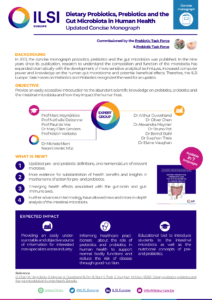
Commissioned by the Prebiotics and Probiotics Task Forces.
[post_title] => Dietary Probiotics, Prebiotics and the Gut Microbiota in Human Health [post_excerpt] => [post_status] => publish [comment_status] => closed [ping_status] => closed [post_password] => [post_name] => dietary-probiotics-prebiotics-and-the-gut-microbiota-in-human-health [to_ping] => [pinged] => [post_modified] => 2023-02-06 13:36:16 [post_modified_gmt] => 2023-02-06 13:36:16 [post_content_filtered] => [post_parent] => 0 [guid] => https://ilsi.eu/?post_type=publication&p=10626 [menu_order] => 0 [post_type] => publication [post_mime_type] => [comment_count] => 0 [filter] => raw ) [2] => WP_Post Object ( [ID] => 10921 [post_author] => 24 [post_date] => 2022-05-31 08:54:54 [post_date_gmt] => 2022-05-31 08:54:54 [post_content] =>Alternatives to Animal Testing in Food Safety, Nutrition and Efficacy Studies
NEW APPROACHES FOR FOOD SAFETY
Background: Methods and approaches that can be used in food and nutrition research are changing at a faster pace than ever. Whereas animal methods are mostly known for their use in food safety analysis (see Part I), they also play in important role in proof-of-concept and mechanistic studies of products, as well as studying potency, efficacy, and tolerance of foods and food ingredients. Members of the International Life Sciences Institute (ILSI) Europe have formed an expert group to review possibilities, opportunities, and challenges for the potential use of alternative testing strategies in nutrition research and regulatory requirements, supporting the 3Rs principle of Replacement, Reduction, Refinement of animal research, which can ultimately be used in support of regulatory submissions for pre-market authorisation.Scope and approach: For the different areas of food for specific groups and health claims, the acceptability of non-animal approaches is evaluated in comparison to legislative requirements in Europe. The alternative approaches considered cover emerging tools and methodologies such as organoids, organs-on-a-chip or human in vitro gastrointestinal simulators.
Conclusions: In nutrition research, there has been a long tradition of following a certain experimental trajectory for grounding scientific hypotheses starting from in vitro data moving on to in vivo verification in a preferred animal model and finally proving this in a human setting. From a regulatory perspective there is no specific requirement for animal experimentation that justifies the use of the majority of animal experiments in the
assessment of nutritional content and value of food products. However, animal data are mostly considered as the standard, and guidance for alternative approaches that would be accepted is lacking. It is therefore important to further build evidence and offer validation for the adequacy of already existing in vitro tools to ensure their suitability for substantiating dose levels and further planning clinical trials. What are we waiting for? Keywords Expand
Non-animal testing, Nutrition research, Regulation
To download this open-access article, please click here.
This work was commissioned by the Alternatives to Animal Testing in Food Safety, Nutrition and Efficacy Studies Task Force.
[post_title] => Animal-free strategies in food safety & nutrition: What are we waiting for? Part II: Nutrition research [post_excerpt] => [post_status] => publish [comment_status] => closed [ping_status] => closed [post_password] => [post_name] => animal-free-strategies-in-food-safety-nutrition-what-are-we-waiting-for-part-ii-nutrition-research [to_ping] => [pinged] => [post_modified] => 2023-04-13 14:52:34 [post_modified_gmt] => 2023-04-13 14:52:34 [post_content_filtered] => [post_parent] => 0 [guid] => https://ilsi.eu/?post_type=publication&p=10921 [menu_order] => 0 [post_type] => publication [post_mime_type] => [comment_count] => 0 [filter] => raw ) [3] => WP_Post Object ( [ID] => 10663 [post_author] => 24 [post_date] => 2022-04-13 16:14:07 [post_date_gmt] => 2022-04-13 16:14:07 [post_content] =>Food Allergy Task Force
NEW APPROACHES FOR FOOD SAFETY
Quantitative risk assessment (QRA) for allergens exists in many different forms with different requirements placed on the risk assessor depending on the question that needs to be answered. An electronic workshop held in October 2020 and comprising representatives from a wide range of food allergy and allergen stakeholder groups identified that a summary of current best in class guidance, identified gaps, potential improvements & harmonization of allergen QRA arising largely from cross contact would be very beneficial. The current manuscript provides an introduction to allergen QRA and an overview of inputs potentially needed for different QRA methods, when deemed feasible and necessary. It also introduces the European branch of the International Life Sciences Institute (ILSI Europe) Expert Group (EG), created to attempt to achieve consensus on the methodologies needed for allergen QRAs by food business operators, and their implementation. Areas of focus include proactive assessments for food production under normal conditions, both in the upstream supply chain and in food production facilities, and reactive assessments as part of an allergen incident response. As a follow-up report to the October 2020 electronic workshop, the current manuscript provides an overview of allergen QRA and insights into the guidance being developed. This manuscript will itself be followed by more detailed guidance for allergen QRA published open access as an ILSI Europe report.
Link to download the full-text
Keywords ExpandAllergens; Quantitative risk assessment (QRA); Supply chain; Incidents; Cross-contact; Precautionary allergen labelling (PAL)
[post_title] => Allergen quantitative risk assessment within food operations: Concepts towards development of practical guidance based on an ILSI Europe workshop [post_excerpt] => [post_status] => publish [comment_status] => closed [ping_status] => closed [post_password] => [post_name] => allergen-quantitative-risk-assessment-within-food-operations-concepts-towards-development-of-practical-guidance-based-on-an-ilsi-europe-workshop [to_ping] => [pinged] => [post_modified] => 2023-01-04 11:38:08 [post_modified_gmt] => 2023-01-04 11:38:08 [post_content_filtered] => [post_parent] => 0 [guid] => https://ilsi.eu/?post_type=publication&p=10663 [menu_order] => 0 [post_type] => publication [post_mime_type] => [comment_count] => 0 [filter] => raw ) [4] => WP_Post Object ( [ID] => 10609 [post_author] => 24 [post_date] => 2022-03-29 08:35:38 [post_date_gmt] => 2022-03-29 08:35:38 [post_content] =>The "totality" of the human exposure is conceived to encompass life-associated endogenous and exogenous aggregate exposures. Process-related contaminants (PRCs) are not only formed in foods by heat processing, but also occur endogenously in the organism as physiological components of energy metabolism, potentially also generated by the human microbiome. To arrive at a comprehensive risk assessment, it is necessary to understand the contribution of in vivo background occurrence as compared to the ingestion from exogenous sources. Hence, this review provides an overview of the knowledge on the contribution of endogenous exposure to the overall exposure to putative genotoxic food contaminants, namely ethanol, acetaldehyde, formaldehyde, acrylamide, acrolein, α,β-unsaturated alkenals, glycation compounds, N-nitroso compounds, ethylene oxide, furans, 2- and 3-MCPD, and glycidyl esters. The evidence discussed herein allows to conclude that endogenous formation of some contaminants appears to contribute substantially to the exposome. This is of critical importance for risk assessment in the cases where endogenous exposure is suspected to outweigh the exogenous one (e.g. formaldehyde and acrolein).
Link to download the full-text
Keywords ExpandEndogenous exposure; Exposome; Genotoxins; Process-related contaminants
Commissioned by the Food Contaminants Task Force.
[post_title] => The role of endogenous versus exogenous sources in the exposome of putative genotoxins and consequences for risk assessment [post_excerpt] => [post_status] => publish [comment_status] => closed [ping_status] => closed [post_password] => [post_name] => the-role-of-endogenous-versus-exogenous-sources-in-the-exposome-of-putative-genotoxins-and-consequences-for-risk-assessment [to_ping] => [pinged] => [post_modified] => 2023-01-04 16:20:28 [post_modified_gmt] => 2023-01-04 16:20:28 [post_content_filtered] => [post_parent] => 0 [guid] => https://ilsi.eu/?post_type=publication&p=10609 [menu_order] => 0 [post_type] => publication [post_mime_type] => [comment_count] => 0 [filter] => raw ) ) [post_count] => 5 [current_post] => -1 [before_loop] => [in_the_loop] => [post] => WP_Post Object ( [ID] => 10886 [post_author] => 24 [post_date] => 2022-05-30 07:04:45 [post_date_gmt] => 2022-05-30 07:04:45 [post_content] =>Obesity and Diabetes
Nutrition Security and Societal Aspects
Background: The gold-standard techniques for measuring insulin sensitivity and secretion are well established. However, they may be perceived as invasive and expensive for use in dietary intervention studies. Thus, surrogate markers have been proposed as alternative markers for insulin sensitivity and secretion. This systematic review aimed to identify markers of insulin sensitivity and secretion in response to dietary intervention and assess their suitability as surrogates for the gold-standard methodology. Methods: Three databases, PubMed, Scopus, and Cochrane were searched, intervention studies and randomised controlled trials reporting data on dietary intake, a gold standard of analysis of insulin sensitivity (either euglycaemic-hyperinsulinaemic clamp or intravenous glucose tolerance test and secretion (acute insulin response to glucose), as well as surrogate markers for insulin sensitivity (either fasting insulin, area under the curve oral glucose tolerance tests and HOMA-IR) and insulin secretion (disposition index), were selected. Results: We identified thirty-five studies that were eligible for inclusion. We found insufficient evidence to predict insulin sensitivity and secretion with surrogate markers when compared to gold standards in nutritional intervention studies. Conclusions: Future research is needed to investigate if surrogate measures of insulin sensitivity and secretion can be repeatable and reproducible in the same way as gold standards.
Keywords ExpandInsulin Sensitivity; Insulin Secretion; Gold Standard; Surrogate Markers; Dietary Intervention Studies
To download this open-access article, please click here.
This work was commissioned by the Obesity and Diabetes Task Force.
[post_title] => The Use and Effectiveness of Selected Alternative Markers for Insulin Sensitivity and Secretion Compared with Gold Standard Markers in Dietary Intervention Studies in Individuals without Diabetes: Results of a Systematic Review [post_excerpt] => [post_status] => publish [comment_status] => closed [ping_status] => closed [post_password] => [post_name] => the-use-and-effectiveness-of-selected-alternative-markers-for-insulin-sensitivity-and-secretion-compared-with-gold-standard-markers-in-dietary-intervention-studies-in-individuals-without-diabetes-res [to_ping] => [pinged] => [post_modified] => 2022-05-31 09:10:37 [post_modified_gmt] => 2022-05-31 09:10:37 [post_content_filtered] => [post_parent] => 0 [guid] => https://ilsi.eu/?post_type=publication&p=10886 [menu_order] => 0 [post_type] => publication [post_mime_type] => [comment_count] => 0 [filter] => raw ) [comment_count] => 0 [current_comment] => -1 [found_posts] => 429 [max_num_pages] => 86 [max_num_comment_pages] => 0 [is_single] => [is_preview] => [is_page] => [is_archive] => [is_date] => [is_year] => [is_month] => [is_day] => [is_time] => [is_author] => [is_category] => [is_tag] => [is_tax] => [is_search] => [is_feed] => [is_comment_feed] => [is_trackback] => [is_home] => 1 [is_privacy_policy] => [is_404] => [is_embed] => [is_paged] => 1 [is_admin] => [is_attachment] => [is_singular] => [is_robots] => [is_favicon] => [is_posts_page] => [is_post_type_archive] => [query_vars_hash:WP_Query:private] => a55ff190b46cec82b1286c09c4572e35 [query_vars_changed:WP_Query:private] => [thumbnails_cached] => [allow_query_attachment_by_filename:protected] => [stopwords:WP_Query:private] => [compat_fields:WP_Query:private] => Array ( [0] => query_vars_hash [1] => query_vars_changed ) [compat_methods:WP_Query:private] => Array ( [0] => init_query_flags [1] => parse_tax_query ) )